
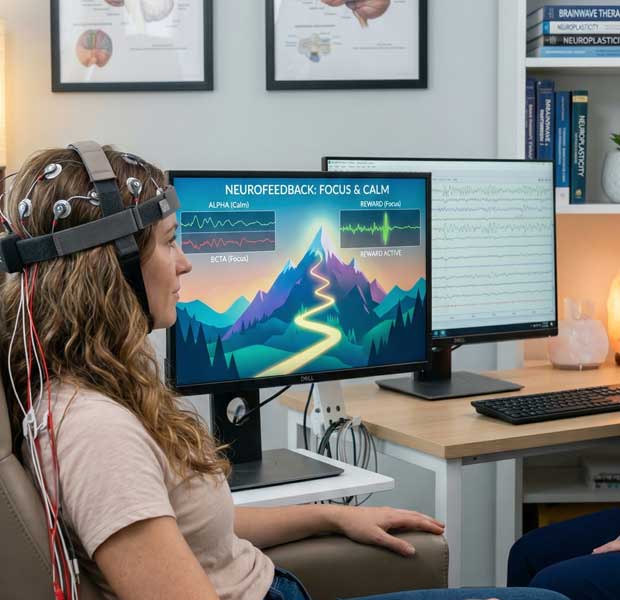
Most people who find their way to neurofeedback therapy have already tried a lot of other things. Medication that helped some but not enough. Talk therapy that gave them tools but didn’t quiet the noise.
The feeling of being stuck in a pattern their own mind couldn’t seem to break. If that sounds familiar, neurofeedback therapy may be something worth understanding.
At Complete Mind Care, we offer neurofeedback therapy at both our Villanova and Horsham, PA locations as part of a comprehensive, integrative approach to brain health.
It is not a replacement for everything else. But for the right person, it changes things in a way that nothing else quite does. The first step is a free consultation, so let’s talk.
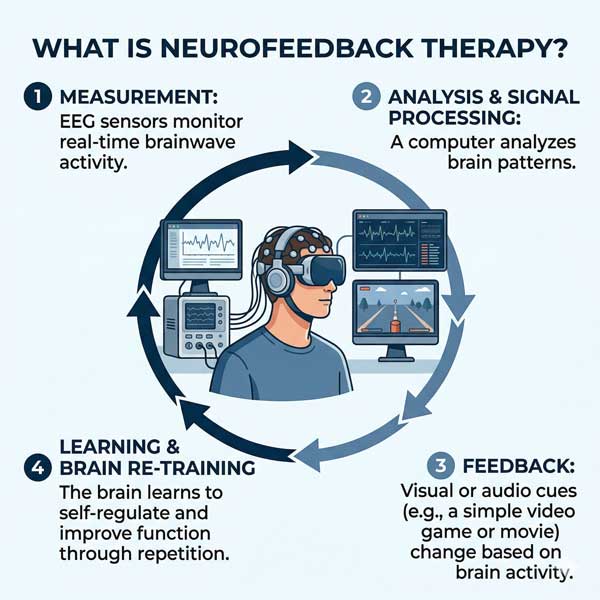
Neurofeedback therapy is a non-invasive, drug-free form of brain training that teaches your brain to regulate itself more effectively. It is also called EEG biofeedback or neurotherapy, and it is grounded in decades of clinical research.
Here is the simplest way to understand it. Your brain produces electrical activity in patterns called brainwaves. When those patterns become dysregulated, you feel it, as anxiety that won’t settle, focus that slips away, sleep that won’t come, or moods that seem to have a life of their own.
Neurofeedback therapy works by showing your brain what it is doing in real time and rewarding it for shifting toward healthier, more balanced patterns.
Nothing is sent into your brain. No medication is involved. The technology simply observes, reflects, and reinforces.
Neurofeedback therapy is remarkably versatile. At Complete Mind Care, our trained clinicians use it to address a range of mental health and neurological conditions, including:
Anxiety often reflects a brain stuck in high-alert mode, with beta brainwave activity running faster and louder than it should. Neurofeedback therapy helps the brain learn to calm those patterns, reducing the physical and emotional symptoms of anxiety without adding another medication to the list.
Trauma leaves a mark on the nervous system that talk therapy alone does not always fully reach. Neurofeedback therapy works at the neurological level, helping the brain begin to process and release the dysregulation that keeps trauma responses active long after the event has passed.
Attention and focus difficulties are often connected to specific brainwave imbalances, particularly an excess of slow-wave activity in areas responsible for attention and executive function. Neurofeedback therapy addresses those imbalances directly, and research has supported its effectiveness for ADHD across both children and adults.
For individuals on the autism spectrum, neurofeedback therapy can support improvements in social communication, emotional regulation, and sensory processing. It works gently and at the brain’s own pace, making it appropriate even for patients who are sensitive to other forms of treatment.
When the brain struggles to shift out of alert states and into the slower, rhythmic patterns that support deep, restorative sleep, neurofeedback therapy can help retrain those transitions. Patients dealing with chronic insomnia or disrupted sleep often notice meaningful improvements over a full course of therapy.
Following a traumatic brain injury or stroke, the brain’s communication pathways can become disrupted in ways that affect cognition, mood, and physical function. Neurofeedback therapy supports neuroplasticity, the brain’s capacity to form new connections, and may help accelerate recovery and restore function over time.
A lot of treatments work on your symptoms. Neurofeedback therapy works on your brain. That distinction matters more than it sounds.
Medications often require ongoing use to maintain their effects. Talk therapy provides coping strategies, but those strategies depend on the brain that is using them. Neurofeedback therapy, when done correctly and with enough sessions, can create changes in how the brain functions by default. Patients frequently describe it not as feeling better because of something they are taking, but as simply feeling more like themselves again.
It is also, importantly, something you do without putting anything into your body. No sedation. No side effects that ripple into the rest of your day. You come in, sit with the technology for a session, and walk out. Most people return to their regular schedule immediately.

Neurofeedback therapy is a strong option if you:
It is not the right fit for everyone. The best way to know is a proper assessment with one of our clinicians. If neurofeedback therapy is not the right direction for you, we will tell you honestly, and we will talk through what else might help.
Yes. Neurofeedback therapy has been used clinically for more than four decades and carries a strong safety record. It is non-invasive and does not introduce any electrical current or substance into your brain. The technology observes and reflects your brainwave activity, nothing more.
Most patients see meaningful changes over the course of 20 to 40 sessions, though this varies by condition and individual response. Your clinician will set realistic expectations at the start of your therapy and monitor your progress throughout.
Absolutely. You do not need to stop or change your current medication to begin neurofeedback therapy. Many patients use it as a complement to their existing treatment plan. We coordinate closely with your prescribing provider to make sure your care is safe and cohesive.
Some patients notice subtle shifts, better sleep, a quieter mind, or improved focus, within the first several sessions. Meaningful, lasting changes typically develop over the full course of therapy. Neurofeedback therapy is a learning process, and like all learning, it builds over time.
Coverage varies by insurance plan. Our team will help you understand your options and what to expect out of pocket before you commit to anything.
You have been managing symptoms long enough. Neurofeedback therapy at Complete Mind Care in Villanova and Horsham, PA gives your brain something different from anything else in the mental health toolkit, a real opportunity to learn how to work better. Reach out to our team to schedule your free consultation. We are here to help you figure out if this is the right next step.
Complete Mind Care was founded to provide comprehensive mental health support delivered by a team of expert professionals, in a world-class facility close to home — so you can build a lasting foundation for wellness without traveling far to get there. We also accept 40+ insurance carriers, making quality care more accessible.
Don’t see your insurance listed? Call our office at 215-607-7250 or 215-918-7939 to verify coverage.


We serve patients across Montgomery and Delaware Counties, including the Main Line, Abington, Dresher, and surrounding communities.